
Timed with the Israeli Knesset’s passing of a death penalty that will de facto apply exclusively to Palestinians, it’s been one hell of a time for the people standing against these atrocities.
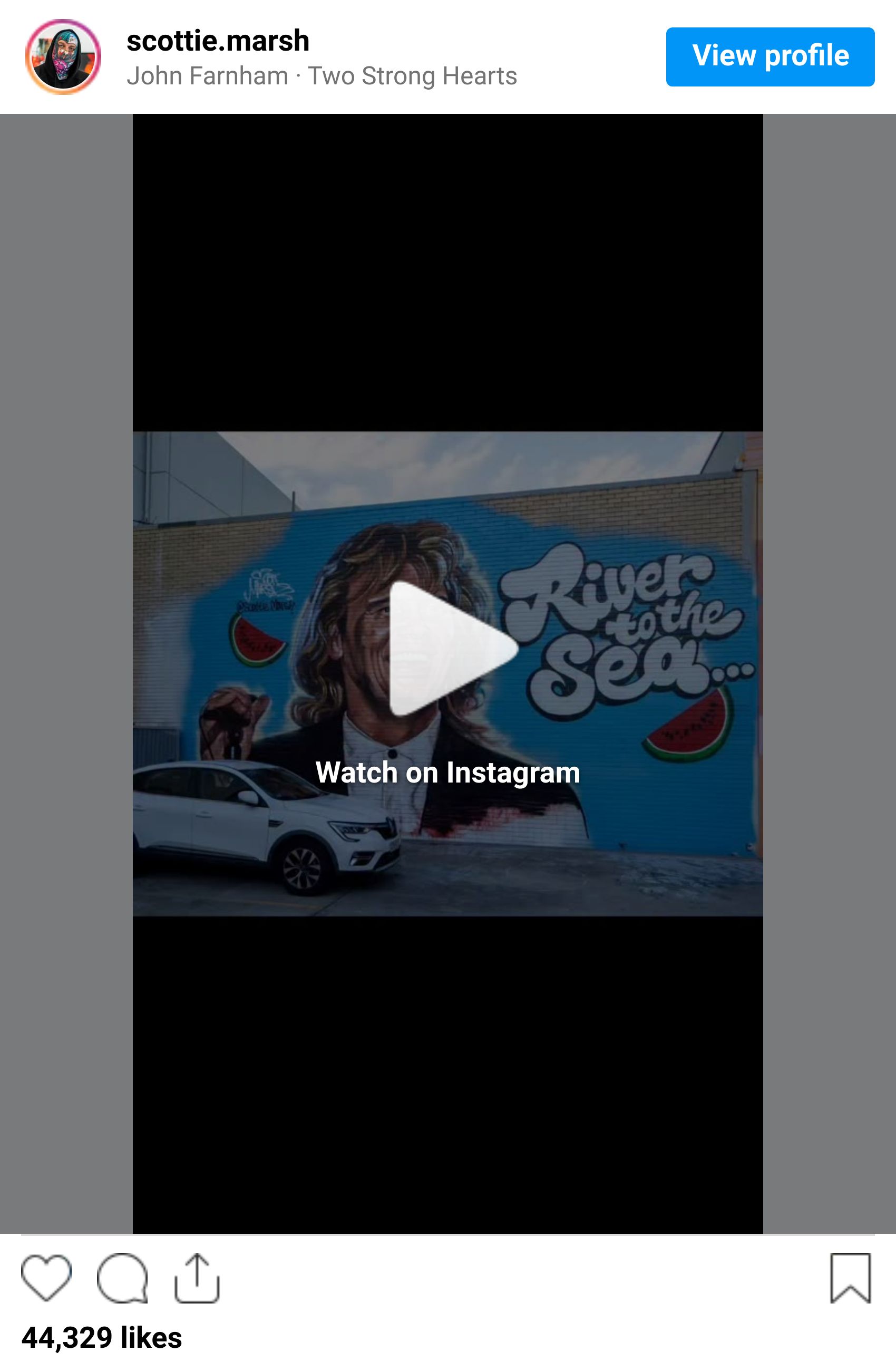
The Thursday before last, NSW police officers broke down the door of a woman in her forties in an early-morning raid because she’d attended the anti-Isaac Herzog protest on 9 February, where she allegedly threw a water bottle at officers and told them not to touch her. A day just before that, the artist James Hillier (known as Nordacious) received a phone call from the Queensland police warning him to take down several of the artworks on his online store; which ones weren’t specified but we all know the depiction of eighteen-year-old Bonnie Carter being arrested for wearing a singlet displaying the words FROM THE RIVER TO THE SEA was definitely one of the pop arts in QPS’ sights. Separately, QPS additionally stated they were investigating Scott Marsh’s mural of John Farnham also using that phrase in Magan-djin/Brisbane ‒ a cheekily-Palestine-themed tribute to his 1988 hit song Two Strong Hearts.

Bonnie Carter’s arrest took place on 11 March, one week after Queensland’s new anti-protest laws were passed; Nordacious released this artwork on 13 March; he received a police warning on 25 March.
Overseas, Qesser Zurah was arrested in the UK on the Sunday before Easter, presumably for posting an Instagram Story with the words TAKE DIRECT ACTION by officers wearing face coverings not dissimilar to those worn by ICE agents in the US (which has long been targeted pro-Palestine activists). She’d just been released on bail last month after charges against her and 22 co-defendants over a break-in at an Elbit Systems manufacturing plant were dropped. She and some other members of the Filton 24 were arrested in November 2024 for charges that would normally go for a maximum of six months before going to trial. Because of this injustice ‒ and alleged mistreatments inside prison ‒ she went on a hunger strike late last year for almost fifty days, alongside seven other activists from Palestine Action Group.

Image taken at the Wage Peace vigil for the hunger strikers outside the UK consulate in Naarm/Melbourne on 30 December 2025, at which point Zurah had paused her strike after 48 days of fasting.
Whilst 23 of the Filton 24 were released on bail, Samuel Corner still remains in custody for striking a police officer during the break-in. His defence argues, however, that he believed himself to be acting in defence of his comrades, as he’d been exposed to PAVA spray and therefore only heard his comrades’ ‘bloodcurdling’ (a police officer’s words describing the women she arrested) screams and lacked the sight to ascertain their condition.
Meanwhile, other hunger strikers who belong to the Brize Norton 5 have been in remand since July last year, with their trial expected to start in January next year.
Similarly, the trial against the Ulm 5 is set to begin at the end of this month, though their defence notes it should already have begun by late March at the latest. Whilst they stand accused of a non-violent direct action, the German state has been holding them under terrorist charges, which has allegedly led to several human rights abuses during their pre-trial detention. And in France, EU parliamentarian Rima Hassan was arrested last Thursday for a post allegedly glorifying a Japanese terrorist group, after she was reported by far-right politician Matthias Renault.
Hassan was also a participant in the Global Sumud Flotilla last year and alleges she was assaulted by Israeli prison guards after the fleet’s illegal interception by Israeli military last October. The flotilla’s next attempt to break the naval blockade around Gaza is set to launch on Sunday, even as members of the coalition remain in prison in Tunisia after they were arrested last month.
Back at home, seven women were arrested on the Friday before last across Naarm/Melbourne. Several homes were raided ‒ though in one instance, police allegedly got the wrong address ‒ in the early morning; an eighth woman’s home was raided on Monday morning, despite her already having a midday appointment at her local police station. These women were handed extremely restrictive bail conditions, which in one case were already partly thrown out by the magistrate when one of the arrested individuals went to court.
What were these women’s crimes, I hear you ask?
Police allege they damaged the statue of Zelda D’Aprano outside Victorian Trades Hall on Friday 6 March. They say the women ‘have been charged with a range of offences including criminal damage, behaving in a riotous manner in a public place, marking graffiti on a residence without consent, recklessly damaging part of a registered place without a permit and refusing to leave scheduled public place after a warning.’
I’ve already given you a bit of context around the other police actions, so you can guess what the women’s motives had been for their action. But if you, like me, already knew what took place in front of Trades Hall on 6 March, you’d be even more sceptical of that statement.
That Friday morning, a group of activists arrived at Trades Hall, where an event for International Working Women’s Day was taking place. They draped an apron on the statue of D’Aprano, with the words DIFFICULT WOMAN embroidered on it. They spray painted the same words on the footpath before the statue, as well as some other phrases in the immediate surrounds. Words were also written on the base of the statue in chalk.

The statue of D’Aprano is called Chain Reaction and it was commissioned, along with five other statues, as part of the Victorian Women’s Public Art Program in 2022. These statues came about after years of lobbying from the advocacy group A Monument Of One’s Own, who fight to ‘smash the bronze ceiling’ ‒ to raise the percentage of statues honouring women in the country’s capital cities from its woeful current level of 15%.
Chain Reaction is a recreation of the photograph of one of D’Aprano’s 1969 actions when she chained herself to the front of the now-demolished Commonwealth Centre Building in protest against a decision by the Arbitration Court in an equal pay case brought about by the Australasian Meat Industry Employee’s Union, where she held an office position. The first action was on 21 October and ended with Commonwealth Police cutting her free after several hours, but ten days later she repeated the action with Alva Geikie and Thelma Solomon, from the teachers’ union, and chained herself to the building of government offices once more.

The chains used in D’Aprano’s first action were apparently donated by the Painters & Dockers Union, whilst D’Aprano herself procured the lock. Photo: Fairfax Media
Together with Geikie and Solomon, D’Aprano formed the Women’s Action Committee and Women’s Liberation Centre in 1970. In 1972, the Arbitration Commission recognised in a second equal pay case the legal right for ‘equal pay for work of equal value’.
Former Labor Prime Minister Julia Gillard unveiled Chain Reaction in 2023. Ironically, however, in 2025, current Labor premier Jacinta Allan introduced the Justice Legislation Amendment (Police and Other Matters) Bill that would criminalise the use of ‘attachment devices’ like the chains D’Aprano used in 1969.

In a creative act of defiance, one of the regular participants at events organised by the Defend Dissent Coalition often turns up dressed up as D’Aprano.
These women were pointing out that very hypocrisy at their action on 6 March. The words DIFFICULT WOMAN honoured not just D’Aprano ‒ who, let’s be clear, was certainly considered a difficult woman ‒ but also Grace Tame, who’d been labelled ‘difficult’ by Prime Minister Anthony Albanese barely a fortnight earlier, a remark that isn’t only sexist but also, given Tame’s autism, ableist to a certain degree as well.
This obvious connection seemed to be lost on Victorian Trades Hall Council Secretary Luke Hilakari, however, who posted the activists’ photos online and announced that he’d called the police on these women. In that social media post, he referred to them as ‘claiming to be left’, encouraging the social media speculation that these women were ‘anti-feminist’ because they specifically used an apron in their action.

This is just the tip of the iceberg at how ridiculous it gets, but let’s be real: aprons weren’t invented for the 1950s kitchen, they were born out of the necessity of keeping clothing clean when you didn’t have a washing machine to get the laundry done easily. An apron is the quintessential wardrobe staple for a working woman who’s not afraid to get dirty, which D’Aprano was.
This is also reflected in the words of the activists themselves, who responded to Hilakari’s outrage with their own statement, jokingly entitled ‘ZeldaGate’:
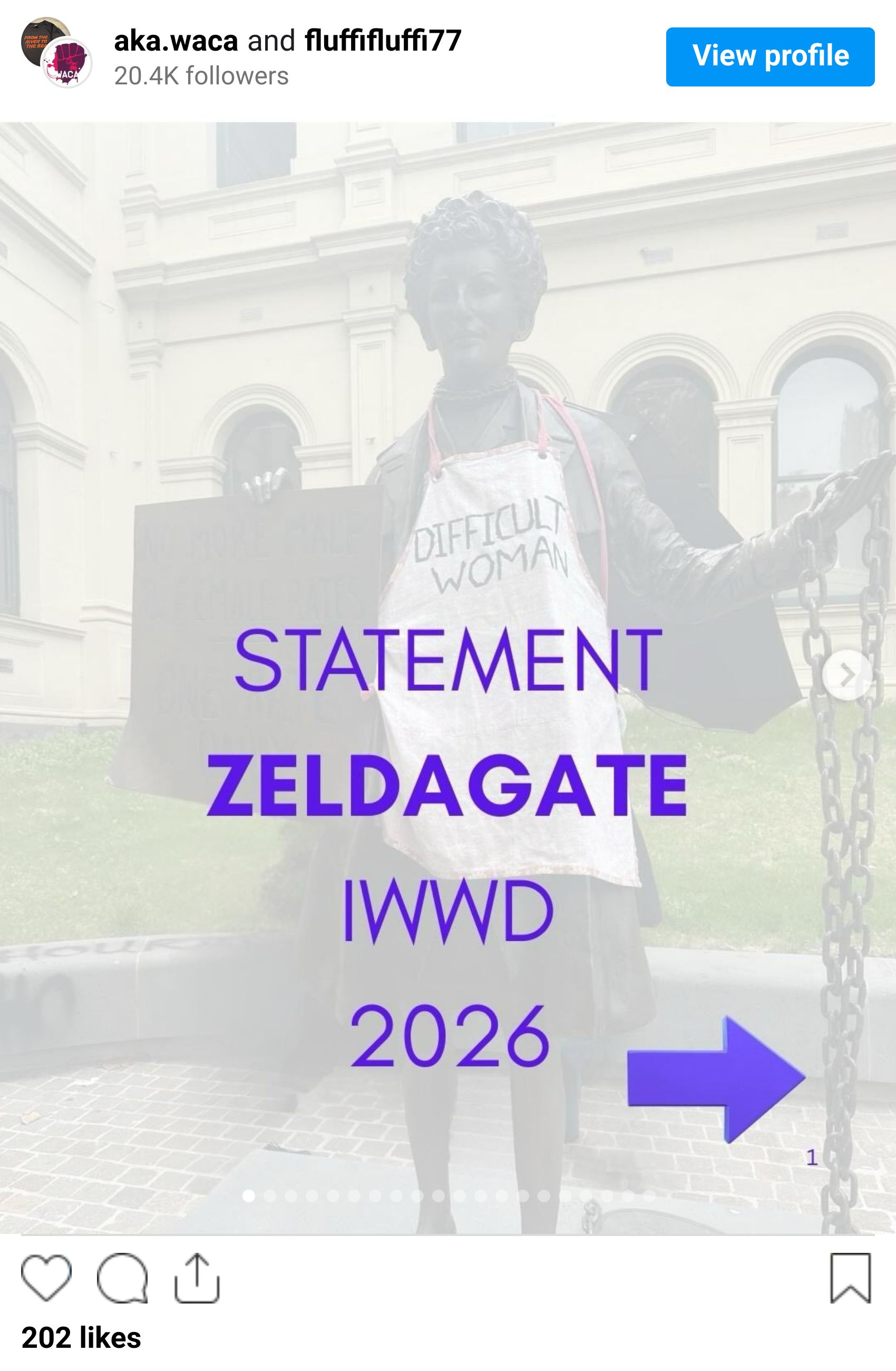
Perpetually at work but never ‘a worker’ from the perspective of a patriarchal trade union leadership, unpaid/underpaid women across the globe have borne the labour of reproducing life in service of capital, while being hidden from the world and risking punishment if they dare speak about or act on the conditions of oppression and exploitation endured…The autonomous feminists broke the symbolic chains of patriarchal capture that act to domesticate femme activists and to discipline ‘difficult women’ inspired and activated by revolutionary icons such as Zelda D’Aprano.
This obviously hasn’t stopped the absurdisms in the comments section, who are demanding to know the name of the activist group the police claimed in their statement that these women belonged to. What they don’t realise is that it’s unclear which activist group the police believe these women belong to, because very few activists belong to only the one. After one of the activists was publicly named in the media, social media consensus is that police were referring to the Whistleblowers, Activists and Communities Alliance, though according to the arrestees themselves, not all of them are active members of WACA.
WACA has been associated with (but to be clear, not found responsible for) vandalism to statues before: monuments to colonialism are frequently damaged by left-wing groups to make the glorification of the dispossession and genocide of First Nations people in this country untenable. This seems to go against the intentions of A Monument Of One’s Own, as its co-convenor Prof. Clare Wright wrote in 2019, ‘I don’t want to tear statues down. I want to build more of them.’
What happened at Trades Hall was not damage to Chain Reaction at all. Only the spray paint, which was used around the statue and not on it, could have left lasting damage, and that depends upon what type of paint that was used. It’s possible the paint would already be gone by the next time it rained. Unlike with other monuments, the activists showed a good deal of respect for D’Aprano.
Hilakari apparently experienced their actions as physically aggressive. They counter Hilakari’s allegation with accusations and examples of violence from female trade unionists directed at them in their own statement. Since these activists were charged by police, they still maintain that none of the violence anyone may have experienced came from their side and insist footage of the incident will back up this version of events.
Further, it’s believed Hilakari made this out to be antisemitic vandalism, for no other reason than that D’Aprano was Jewish. The fact that they used red paint is used to back up this case online, as if red isn’t associated with many causes ‒ say, the Communist Party, which D’Aprano was a member of for over two decades until she resigned over its male-dominated environment. Another count against these women are the pictures of one of them wearing a keffiyeh, because being pro-Palestine obviously means you’re antisemitic.
That’s sarcasm, by-the-by. It should be obvious, but if police already think draping an apron on a statue warrants involving counter-terrorism and riot officers, then who knows what else people will believe these days.
Victoria Police doesn’t, however, seem to believe a signed witness statement from a man admitting to taking photos of women changing in a private vehicle warrants investigating him. Nor do police consider these photos as evidence of any sort of inappropriate behaviour at all. Instead, these photos are being used to prosecute these women.
As for the photos of their action, Hilakari has kept those up on social media so the public may also identify these activists. He only blurred two of these individuals’ faces when they personally contacted him to remove the photos of them, but in doing so, these women had to identify themselves as participants in the action. He argues for the public naming and shaming of these women ‒ after all, he’s never hidden anything he’s done as an activist, so why should others be allowed to remain anonymous?
That Allan’s anti-protest bill is also criticised for its anti-mask provisos, that police use our very act of wearing them as justification to unleash OC spray on peaceful protesters, seemingly eludes his grasp here. That legal activist groups, people whose opinion he should value as a unionist, point out that the United Nations Human Rights Council recognises that ‘the mere fact that a particular assembly takes place in public does not mean that participants’ privacy cannot be violated’, conveniently escapes his notice.

Hilakari addresses the allegation of doxxing on social media.

In other social media posts about the arrests, Zionists fantasise about exposing these women to retribution.
Normally, I can very well imagine that a white cishet man is blind to his own privilege (I’m only being half-sarcastic here). But yes, in this case I doubt that he’s truly ignorant of any of this. After all, if he were, he wouldn’t have taken out an IVO against the women involved in this action.
As a result of this IVO, these women ‒ who’ve taken on the moniker the ‘Zelda8’ ‒ may not contact Hilakari or Trades Hall in any way. They’ve had to negotiate with police to ensure they can at least travel around the city, lest police use their movements on public transport as proof they violated their bail conditions. Furthermore, however, they may not post anything that mentions Hilakari or Trades Hall. Nor may they repost anything, such as, for instance, this piece.
In taking this step, Hilakari ensures his is the only narrative that people know. He spins the Zelda8 as anti-feminist, antisemitic, anything to justify their mistreatment at the hands of police ‒ including the denial of medication or the withholding of legal support ‒ and they may not speak out against it. The police also imposed non-association orders on the Zelda8, meaning they may not interact with one another. The magistrate has already thrown out this order against one of the Zelda8, so we can imagine a similar outcome awaits the others when they face court. But in the meantime, they face additional barriers in organising.
This very action is illustrative of the very culture the Zelda8 were calling out on 6 March. Union leaders in this country face ongoing accusations of being captured by self-interest. We see union flags at protests, Hilakari himself has been a speaker at pro-Palestine rallies, but no industry-wide strikes have taken place. Union leadership claims their members aren’t ready to take action for Palestine, but when unionists themselves organise actions amongst one another, the leadership won’t support them.
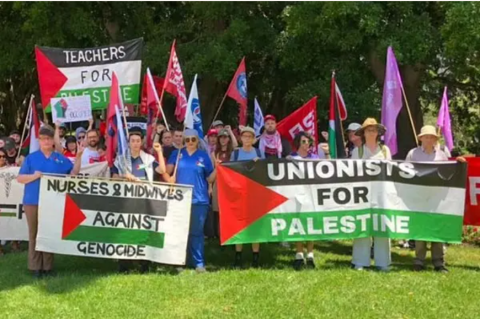
Italian dockworkers shut down trade across their country last year when the Global Sumud Flotilla was intercepted. Meanwhile, we have a protestival every year with the aim of shutting down the world biggest coal port ‒ and it’s organised by Rising Tide, an environmental action group. There are frequent actions in Port Melbourne attempting to stop the shipment of arms to Israel, but why are these mostly undertaken by activists and not unionists?
In sending the police after anti-war activists, Trades Hall actively sabotages the pro-Palestine movement as a whole. The 6 March action, as I’ve said, was incredibly restrained. When the activists with restraint are all shut out from actions, the agitators take point. And when Trades Hall make themselves a target for actions, they really don’t want the agitators there.
Trades Hall is the oldest of its kind in the world, but its leadership hasn’t even learned from its own history. Today, they venerate Zelda D’Aprano, but in her time, she was cast out from the unions because women’s rights weren’t seen as important and because she was considered too radical. Protest and advocacy are important, yes, but no movement succeeds without direct action. D’Aprano herself came to that conclusion, in the very action Chain Reaction has immortalised in stone:
I realised that unless we did something outlandish, no one would even know, because they controlled the press, and they’d just leave out anything that was positive about women.