
It’s Monday, half past nine in the evening. I’m seated at my desk, speakers blasting Gang of Youths’ emotionally devastating 2022 album angel in realtime as I go through my tabs, hoping to finally get through all of the news articles from December. Alas, there are at least 13 still to go. A new email notification pops up on my screen: The Red Hand Files Issue #355, this week’s edition of Nick Cave’s mailing list, where he answers letters from across the world.
From a quick glance, I realise Cave has decided to respond to the Berlinale controversy. I don’t get to it immediately, but, interest piqued, I resolve to get to it once I’ve moved back to cleaning out my inbox. Because I spent the weekend at the Together for Treaty Volunteer Summit organised by Common Threads, 50 more emails have manifested since Friday that I’ve yet to read and sort appropriately, but I want to keep the new unread emails from today to a minimum of five.
Once I get to them, I find Cave’s thoughts to be interesting from the perspective of an artist responding to Wim Wenders’ comment that, as artists, ‘we have to do the work of people and not the work of politicians.’ I found them interesting from the perspective of someone whose relationship with Wenders goes back over four decades. They were certainly, as I expected, written with the same trademark, meaningless inoffensiveness Cave always employs when touching on Israel’s genocide of Palestinians in Gaza. As I read, I debate whether I want to delete the email or keep it in my Society folder instead.
At no point do I consider writing a response. At most, I’m tempted to forward it to friends and ask them what they think. Yes, I have my own thoughts on the matter, but so do many others. A lot has already been written that I agree with and my rule in such circumstances is to highlight these perspectives, from those who are better situated than I, than to weigh into the conversation myself.
Yet buried in one paragraph are four sentences that give me pause.
The furore around the Adelaide Writers’ Week was happening while I was on tour in Australia. In an almost cosmic display of stupidity, that entire event was vaporised in a mushroom cloud of cowardice, performative outrage, self-righteous posturing, cancellations, counter-cancellations, mob trots and general narcissistic silliness. ‘Political art’, taken to its extreme, became ‘no art’. No art at all, as Australia’s longest running literary festival collapsed under a mass walkout.
At first, I’m surprised by the comparison between the 76th Berlin International Film Festival and the 2026 Adelaide Writers Week. Not least because of the scale. Longest-running literary festival notwithstanding, the literary industry in so-called Australia is relatively small, so I doubt the collapse of the Writers Week made international headlines the way the Berlinale is right now. Additionally, whilst the Berlinale’s reputation took considerable damage, the event still took place. The same can’t be said for this year’s Writers Week at the Adelaide Festival, whose entire board resigned amidst the backlash.
It should be clear that I also have opinions on the Writers Week collapse, but again: there are a lot of people, chief amongst them the authors who’d been invited this year, who’ve condemned the Adelaide Festival Board for what happened. It’s a much better use of my efforts to read and share their thoughts on the matter than add my own into the mix.
Furthermore, you don’t start writing anything after 9pm, especially if you’ve overdone it on the painkillers whilst fighting ongoing headaches. I know I’m not thinking straight. So I tell myself to just file away the email if I’m not going to delete it.
But the link between the Writers Week debacle and Berlinale niggles at me. So even as I set aside my emails and my tabs, try reading an old issue of Quarterly Essay I poached from my father’s latest sorting-out and plan yet another crochet project, I find myself formulating sentences and connections.
Now it’s sometime before seven in the morning. I keep my eyes shut, willing myself back to sleep, but the dark against my eyelids is already lightening. If I didn’t know better, I’d say I forgot to take my medication last night, because I started drifting off at one am. I try to trick my brain back into dreaming by planning out what I want to write for the day. Unbidden, I remember the email again.
The problem is, I too can see the similarities between the Writers Week and the Berlinale. Yet if Cave had gone more in-depth with the Writers Week comparison, he’d have had to realise the incorrectness of Wender’s statement.
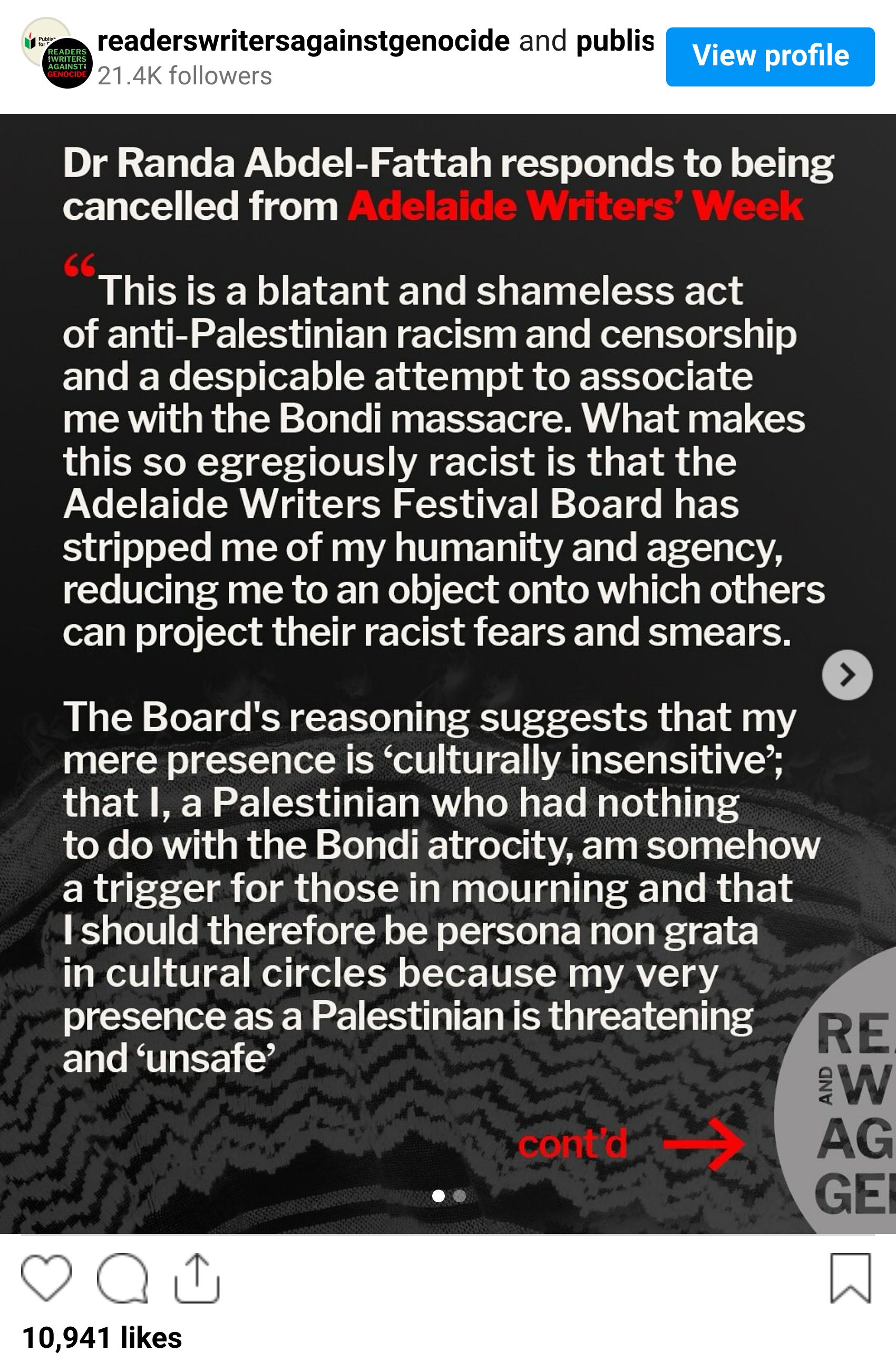
The collapse of the Adelaide Writers Week began with the Adelaide Festival Board’s public statement on 8 January uninviting Dr Randa Abdel-Fattah in ‘the view that it would not be cultural sensitive to continue to program her at this unprecedented time so soon after [the Bondi massacre].’ I’m going to give Cave the grace (not that he’s ever going to read this) to assume this is the ‘cosmic display of stupidity’ and ‘cowardice’ he was referring to, because indeed it was.
Not only was it racist in the way it denied Abdel-Fattah’s humanity as a Palestinian-Egyptian woman, as she pointed out in her own response, but it also went against the express wishes of Adelaide Writers Week Managing Director Louise Adler, an anti-Zionist Jewish woman and the daughter of Holocaust survivors, who explicitly invited Abdel-Fattah after her singling out at the 2025 Bendigo Writers Festival led to the collapse of that event.
As we now know, it was also doing, as Wenders may put it, ‘the work of politicians’. Just a week earlier, South Australian premier Peter Malinauskas sent a letter to the board’s now-former chair Tracey Whiting arguing against Abdel-Fattah’s inclusion. This is an extraordinary step, not in the least because, as Adler pointed out in her resignation letter, he decided against withdrawing funding from the event when similar criticisms were made against Palestinian writers only three years ago as ‘it leads us to a future in which politicians can directly stifle events that are themselves predicated on freedom of speech’. Malinauskas’ letter this year also acknowledges that the Adelaide Festival is independent from the SA government, but it seems that the horrendous weaponisation of the Bondi massacre has led him to change his mind on staying neutral.
The key word here is ‘weaponisation’. Omar Sakr gave one of the best takedowns of this narrative that pro-Palestine protests in Australia led to the Bondi massacre back in December, barely a fortnight after the attack first happened.
[Bondi] had nothing to do with Palestine whatsoever. The killers were not Palestinian, not advocates for human rights, not organisers of rallies [and] the attempt to link this attack, in this specific way, is no more than a sickening retrospective justification for the mass murder of hundreds of thousands of Palestinians, the ongoing colonisation of their land, and genocide.
As it stands, Malinauskas seems determined to keep on making work for himself whilst facing an upcoming state election in March. Following the publication of his letter, and subsequent comments on public radio doubling down on his stance against Abdel-Fattah, she’s now launched legal proceedings against him.
Cave summarises this debacle in four sentences, obscuring who is actually responsible for it occurring. If he’d addressed it in any length, he’d see that the only conclusion you can draw by comparing it with the Berlinale controversy is that Wenders’ words were the tip of a hypocritical iceberg.
Even as Wenders argued against doing ‘the work of politicians’, the very festival he was representing did exactly that. The livestream of the press conference he was speaking at was cut midway through Tilo Jung’s question to the jury, as soon as he mentioned Gaza. It stayed offline for the duration of Wenders’ and fellow juror Ewa Puszczynska’s answers. The Berlinale organisers claim this was due to technical difficulties, but Jung disputes this; the timing was certainly suspicious. (The livestream recording is available in full on the Berlinale website without any annoying technical difficulties.)
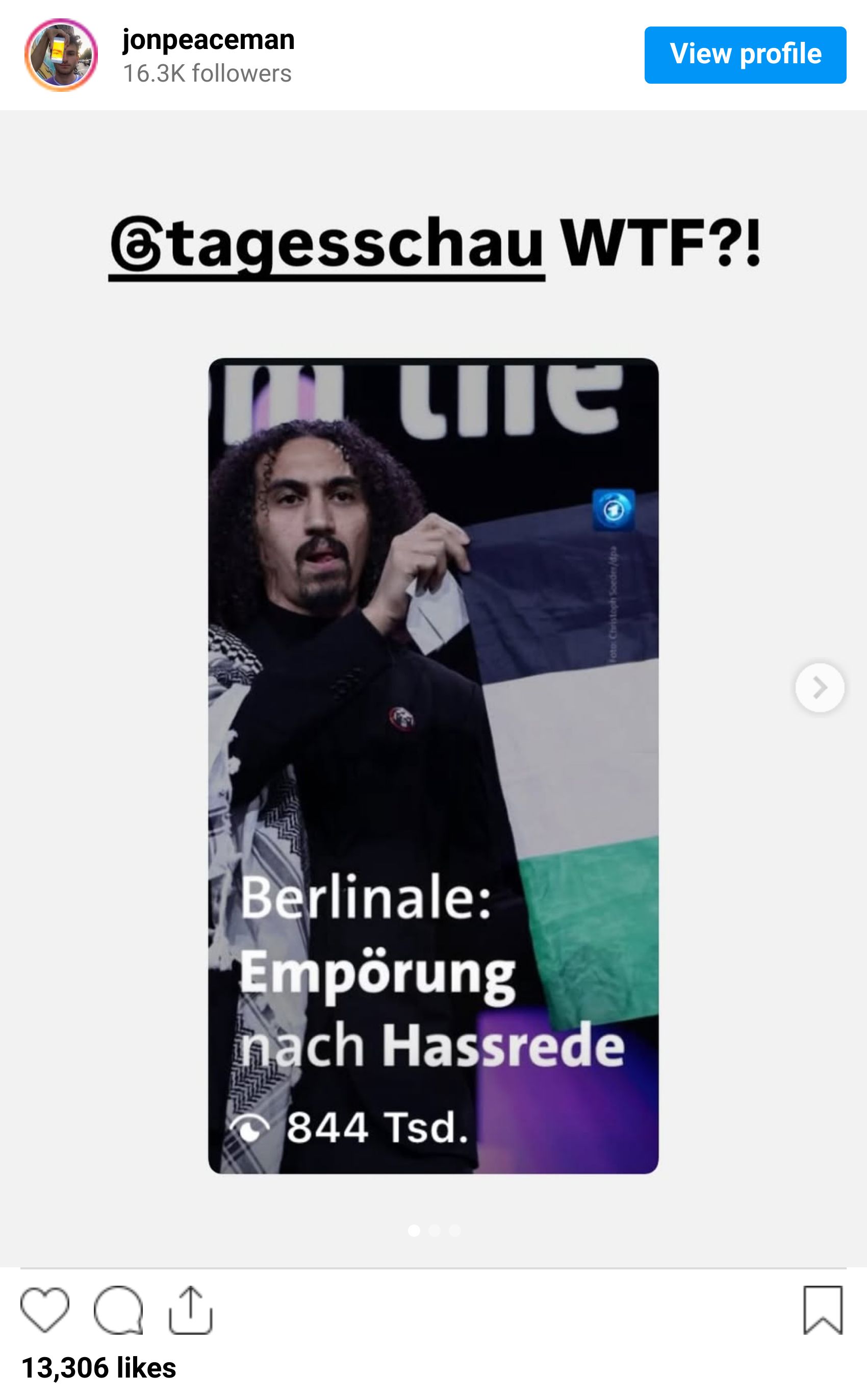
Since that controversial press conference, the German media has gone on the offensive against Jung. Several colleagues have derided him as a ‘YouTube entertainer’ baiting Berlinale members with provocative questions. Online, in news reports and in person, Jung has documented hostility against him and colleagues posing critical questions.
The Berlinale has gone on the defensive, insisting ‘there is free speech at the Berlinale’, but you’d be forgiven for being sceptical given the Berline’s statement spotlighted various other conflict zones but Gaza. You’d be forgiven for being sceptical given it took them nine months to respond to the racism directed at Palestinian filmmaker Basel Adra when he and his Israeli co-director Yuval Abraham accepted their award for the documentary No Other Land two years ago. You’d be forgiven for being sceptical given their non-committal stance following revelations that director Jun Li was being investigated by Berlin police for reading a statement from his star actor Erfan Shekarriz, who was boycotting the festival, that included the phrase ‘from the river to the sea’ ‒ a phrase that’s been banned in Germany for over two years and that Queensland now threatens to ban as well.
It’s no secret why the festival management is so careful. As Hanno Hauenstein explains, ‘like much of Germany’s cultural sector, [the Berlinale] is publicly funded and thus deeply intertwined with Germany’s soft power cultural policy apparatus. It operates in a country whose political establishment routinely invokes Staatsräson (Germany’s proclaimed raison d’état vis-à-vis Israel, derived from the Holocaust) as a symolic doctrine in debates about Palestine. In such a setting, declaring to be “outside politics” is, of course, itself a political stance.’
This is the environment Arundhati Roy was calling out when she announced her withdrawal from the festival.
Although I have been profoundly disturbed by the positions taken by the German government and various German cultural institutions on Palestine, I have always received political solidarity when I have spoken to German audiences about my views on the genocide in Gaza. This is what made it possible for me to think of attending…To hear them say that art should not be political is jaw-dropping. It is a way of shutting down a conversation about a crime against humanity even as it unfolds before us in real time – when artists, writers and film makers should be doing everything in their power to stop it.
Let me say this clearly: what has happened in Gaza, what continues to happen, is a genocide of the Palestinian people by the State of Israel. It is supported and funded by the governments of the United States and Germany, as well as several other countries in Europe, which makes them complicit in the crime.
Only two years ago, Wenders could be heard saying ‘The Berlinale has traditionally always been the most political of the big festivals, won’t hold back right now, won’t do it in future, either.’ In that context, Jung’s question becomes all the more pertinent: how does he reconcile past moral stances on other conflict zones with the silence on Palestine? Will the festival stand in solidarity with the artists calling out German complicity in a genocide, even when that means standing in opposition to one’s own government? Clearly not, as Wenders’ words demonstrated yet again.
Not that these tacit protestations and deafening silence when the public broadcaster labelled Syrian-Palestinian director Abdallah al-Khatib’s speech where he criticised the German complicity on Gaza as hate speech were enough to protect the Berlinale, as rumours circulate that far-right German culture commissioner Wolfram Weimer intends to relieve Tricia Tuttle as director of the festival, showing just how farcical the notion that the festival may make decisions independently of our government truly is.
What is this kowtowing to the government but the cowardice Cave was describing in relation to the Adelaide Writers Week?
And what are the statements of solidarity with Tuttle but the performative outrage he was criticising in the case of Adelaide? They are certainly a lot more performative, in the sense of being ingenuine, when compared with the mass exit of Adelaide.
After all, as Olivia De Zilva wrote when she announced her withdrawal from what was to be her first big festival, ‘for many debut authors, it may mean never appearing at a festival again. The loss of sales could affect the whole trajectory of our careers and the publishers and booksellers who have supported us. It means that we must continue to put more unpaid labour into finding other opportunities to showcase our books and writing.’
De Zilva had a lot more to lose than Tilda Swinton for showing her solidarity with Abdel-Fattah, yet she did so anyway. And not only was the risk for her greater, but she also went further than signing an open letter as Swinton, or simply speaking out against the festival leadership as Channing Tatum did when interviewed on the red carpet; she withdrew from the event altogether.
This, again, is the difference in the scale behind my surprise when Cave decided to compare the Berlinale controversy with the Writers Week debacle. The Writers Week has been cancelled; after Roy withdrew, two Arab-language films withdrew in support and nobody else. Prominent celebrities signed an open letter, condemning the Berlinale’s position but not declaring their own intention of boycotting the event, whilst other celebrities talked to the media about being political at publicity events the festival was hosting. Lebanese director Marie-Rose Osta and al-Khatib used their acceptance speeches to highlight the plight of Palestinians, for which they’ve no doubt risked their careers (and, if the attack by Israeli settlers and subsequent detention by Israeli military of No Other Land co-director Hamdan Ballal is anything to go by, potentially even more), but they’ve still legitimised the Berlinale, as Jewish activist Rachael Shapiro pointed out in a post on social media.
The movement demands that these institutions be BOYCOTTED UNCONDITIONALLY. It does not congratulate you for “making Palestine visible” at your individual discretion…100, 200, 300, 1,000 artists collectively ‒ or even individually ‒ announcing their boycott of a cultural institution like Berlinale with a clear unmistakeable political statement is symbolically and materially impactful. There is no personal gain in it, it is for the good of the cause. And that’s why it is far less common.
Admittedly, what happened at Adelaide didn’t feel that rare to me given we had the precedent of Bendigo. I suppose scale is an important factor in that as well; whilst the Berlinale pulls in attendees from across the globe, our local literary festivals draw from the pool of local talent, with some big-name headliners from overseas. As previously mentioned, we have a relatively small literary industry, so we’re very tight-knit.
The first withdrawals came from Readers and Writers Against the Genocide, that loose collective of publishing professionals that formed in response to the growing censorship of artists. I believe Bundjalong poet Evelyn Araluen was the first to withdraw in solidarity; she’s also credited for spearheading the Bendigo boycott last year. RWAG platformed each public statement of withdrawal and made repeated public statements encouraging any of the less well-established attendees of the 2026 Writers Week to contact them if they feared repercussions for their career. Twenty-four hours after the public disinvitation of Abdel-Fattah, at least fifty authors had withdrawn, including all programmed First Nations names.

Image taken at RWAG ‘Read-In for Palestine’ at the steps of State Library of Victoria on 2 October 2025.
The next authors who withdrew didn’t necessarily do it in solidarity with Abdel-Fattah. Peter Greste, for example, noted that he doesn’t endorse anything Abdel-Fattah has said in the past ‒ which is saying something coming from someone with direct personal experience of political censorship and who’s gone on the record to call out Israeli censorship ‒ but that there was no justification for censoring her. Many others, who might disagree with Abdel-Fattah more vehemently than Greste, also withdrew on the basis that silencing anyone is a mistake.
To my surprise, that even included those whose names have seemingly become intertwined in the public consciousness with the ABC, because after the public broadcaster’s tightening of social media rules following the finding that it unlawfully fired Antoinette Lattouf, it seemed to me that its journalists and commentators had gotten extra careful what they said publicly. Of the other big names, Jacinda Ardern was also a surprise ‒ I’d assumed she’d wait and see what happened in silence. I don’t single these individuals out to pass judgement, simply to emphasise how massive the response to the public disinvitation of one academic was.
Jewish Zionist writer Lee Kofman accuses the literary community of double standards for supporting Abdel-Fattah when she participated in the ‘doxxing’ of her two years ago. And whilst I understand that Kofman has no doubt dealt with a lot in the last two years, her selective framing of the narrative highlights her own hypocrisy. Kofman was exposed when group chats she participated in were leaked to the public because they lobbied for the cancellation of pro-Palestinian figures. In doing so, they directly targeted the livelihood of members in their own community. I don’t know who Kofman has targeted, but we do know that pro-Zionist lobbying was behind the censure of Abdel-Fattah at the Bendigo Writers Festival and, given Zionist Jewish community leader Norman Schueler’s public concession that his community requested Abdel-Fattah’s removal at the Adelaide Writers Week, there may have been a similar campaign there.
I don’t think Cave was referring to Kofman when he referenced ‘counter-cancellations’. More likely, it was the direct accusations of hypocrisy towards Abdel-Fattah and Adler, for their part in lobbying against the inclusion of Zionist columnist Thomas Friedman at the 2024 Adelaide Writers Week. The criticism once again ignores Friedman’s own actions in that: namely, the penning of a column comparing Middle Eastern people to animals. The blatant racism of this should be self-evident as to why Abdel-Fattah and Adler lobbied against Friedman’s inclusion, but if not, I find Abdel-Fattah’s contextualisation of her much-maligned Tweet that Zionists ‘have no right to claim to cultural safety’ to be very well applicable here:
A distinctive feature of cultural safety is that it is the people who have been colonised and harmed by the violence and oppressive practices of settler colonialist systems and discourses who have a right to and are entitled to cultural safety, not those who adhere to, enable, or support racist settler colonial ideologies and practices. The term was not intended to be a cover for those who adhere to a political ideology, nor is cultural safety an entitlement that is equally shared between coloniser and colonised, oppressor and oppressed.
al-Khatib had the right for cultural safety at the Berlinale. Osta had that right. Wenders showed exactly why the Berlinale didn’t offer that to them.
Cave’s reference to the Writers Week serves as speculation that his friend argued to keep politics out of a film festival to prevent the Adelaide Writers Week and 2025 Bendigo Writers Festival’s fate befalling the Berlinale. But perhaps, as Patrick Marlborough argued in the case of Adelaide, we don’t have another choice:
For years, these festivals have worked as fronts and grifts for all parties involved. Authors are there to sell themselves and their books, the organisers are there to sell themselves and cement the need for their existence in Oz art’s top heavy ecosystem, and the audiences are there to sell themselves to themselves as someone who is able to stand up at a Q&A and deliver a comment so beautiful it will heal all wounds in the world…They are not built for the very thing they’re here to peddle: debate/thought/imagination/art. They buckle under the solid reality of real ideas. They sink. They explode. Do you really want to keep paddling around in the bilgewater of their cracked hulls? Yes? Well, ask yourself why.
Cave fears that the result of such a thing is no art at all. But as an artist, he should know that art always finds a way.
In the case of Adelaide, our community is currently holding Constellations: Not Writers Week. This guerilla festival has panels and workshops on all forms and genres, from fantasy to poetry to comics. A conversation between Adler and Abdel-Fattah has already sold out, as have other events featuring notable pro-Palestine voices or voices who’ve faced censorship in recent times like Yanis Varoufakis, Dr Bob Brown, Prof Clare Wright and K.A. Ren Wyld, but I see an event with De Zilva hasn’t, nor has another special event on settler-colonialism facilitated by Chris Sidoti, featuring Francesca Albanese, Henry Reynolds and Lana Tatour, that makes me regretful I can’t go.
In Berlin, meanwhile, the Palinale Film Festival was held in parallel to the Berlinale to boycott the government-run event and not have to deal with the censorship. From what I can tell, it seems like it was a successful event.