
‘Those memories are not history to me; they are part of my life,’ Peter de Waal recounts. ‘Seeing and hearing what unfolded stirred emotions I had hoped never to experience again, yet they returned with a painful clarity.’
On 24 June 1978, queer people marched through the city to Paddington Town Hall, where they held a forum on the international gay rights movement. In the evening, they assembled for the first Mardi Gras, marching behind a single party bus and calling out to the queer people in the clubs and bars they passed to join them. Frustrated police eventually confiscated the bus and arrested its driver, but protesters continued to Kings Cross, where police then blocked off side streets and, once paddy wagons arrived, started arresting members of the crowd en masse.
Violence broke out. 53 protesters were arrested, others escaped. Still, the crowd followed their detained comrades to the police station, calling for their release. Still more violence from the police followed. Still, the crowd stayed, passing around collections to raise bail money for the arrestees. In the following days, the Sydney Morning Herald published the names of the arrested protesters, outing them to the whole world.
By the end of the night on Monday 9 February 2026, 27 people were arrested, several people were injured and five people had to be transported to hospital. Paramedics also treated two police officers at the scene, whilst dozens of protesters required care after exposure to OC spray. The following day, Murdoch outlets circulated the names and personal details of the people to face court.
Eight years ago, NSW Police formally apologised to the Mardi Gras 78ers, the cohort of courageous queers who first protested at the Day of International Gay Solidarity in 1978, which saw the planned street festival dissolved by police and 53 people arrested. Last month, de Waal says, ‘I found myself reliving 24 June 1978 – the horrors, violence, and trauma inflicted by police on the 78ers that night.’
He’s not the only 78er to feel that way. In a public statement, Mark Gillespie relates, ‘It’s unbelievable that this period of time, some 47 or 28 years later, I can experience the kind of violence which is born out of dehumanising others that we gays and lesbians and trans people and others in 78 felt. That I can still experience that today.’
It’s sadly less unbelievable for those of us protesting for our rights and those around the world in the current political climate. Rather, the violence at the Gadigal/Sydney protest in response to the state visit of Israeli president Isaac Herzog following the horrific Bondi massacre felt inevitable.
The violence began at half past seven that evening, when a standoff between police and protesters resulted in the first arrests. Police officers blocked streets, ordering protesters to disperse. Protesters, meanwhile, were demanding to march, which police told them they didn’t have the right to do.
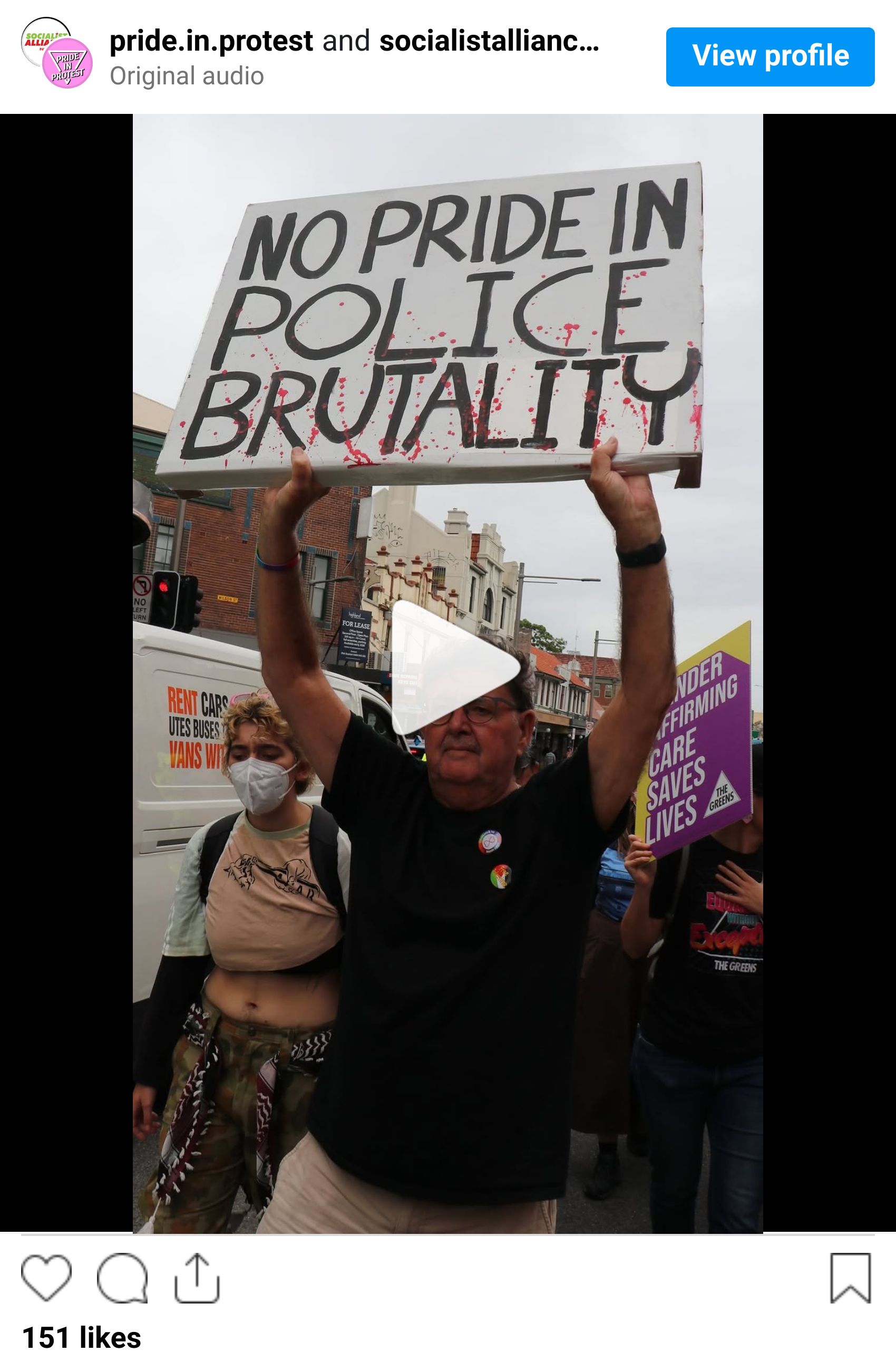
Minutes before the protest began two hours earlier, Justice Robertson Wright knocked back a legal challenge from protesters against the extraordinary powers bestowed upon police during Herzog’s state visit. There wasn’t time for the judge to deliver reasoning, but, as associate professor Maria O’Sullivan explains in The Conversation:
Justice Wright apparently [didn’t] agree with the plaintiffs’ assertion the declaration was unreasonable and had an improper purpose – to suppress a protest. This would have been difficult to prove, given the minister had cited public order and security concerns in his decision, which could be viewed as a proper purpose.
The extraordinary powers used by NSWPF during the state visit make it difficult, now, for the victims to seek compensation or any form of justice at all. Even for the sixteen-year-old who was allegedly dragged by the keffiyeh around his neck and cuffed when a group of Muslim men were interrupted during Maghrib prayer, some even bodily lifted off their feet as they were kneeling. Even for the elderly widow of a Palestinian who had four vertebrae broken after she was allegedly pushed to the ground on top of her, then felt others pushed onto her as she lay there. Even for the man who was called a racial slur and repeatedly punched when he became one of the first known arrests.
The only report from courtrooms relating to the Herzog protest is that of the arrestee in the viral footage of an individual being forced face-down onto light rail tracks by two officers whilst being punched repeatedly. The individual, who apparently breached bail for common assault charges and one domestic violence-related charge (actions I also separately condemn if true) by attending the Herzog protest, was criticised for wearing a keffiyeh by the judge during proceedings, who argued, ‘This is not a place for protest, this is not a place for political opinions, this is a place of law’.
This kind of rhetoric, too, is familiar to us protesters. The truth is that politics has a front-row seat in these courtrooms. In the wake of a tragedy, our prime minister invited the head of another state credibly accused of genocide like the deaths that happened on our shores were all citizens of that country and like the protesters against these war crimes were complicit in the murders. If I’d been on bail, I too would’ve broken curfew to demonstrate against this injustice. Not to mention the actual charges the accused was facing at that trial: the use of violence against the representatives of the state who were actively using violence against him at the same time.
I’m actually much harder on the use of force than some other activists I know, but I need to be clear: if you’re being attacked, the way this protester was, you will lash out. It’s human. That’s why the imperative is on police to remain calm in that situation, because when they use force, they have the full weight of the state behind them. It’s an unbalanced situation on any day; it was way out of whack on 9 February in particular.
The extraordinary police powers being used on 9 February came on top of the fact that NSW already has some of the toughest restrictions on protests in the country, not even counting the special powers hastily rushed in at the end of December last year, when NSW premier Chris Minns recalled parliament in the wake of the Bondi massacre to pass bills tightening gun laws (though, notably, not to the extent that they would’ve prevented the perpetrators from owning the four guns they had at Bondi) and protest restrictions. Effectively, these powers allowed the police commissioner to prevent any marches up to 90 days after a declared terrorist attack, which 14 December was, with a rolling declaration every fortnight.
These were the powers used to prevent protesters from marching on the 18 January protest marking ten years since David Dungay Jr’s death and mourning every death in custody, especially the over 600 deaths that have happened since the 1991 royal commission. These were the powers NSW police commissioner Mal Lanyon was urged to drop before 26 January, which has been Invasion Day for First Nations people since 1788 and a Day of Mourning since at least 1938.
I don’t deny Jewish people the right to mourn after Bondi. But there’s something deeply wrong with this country when police have the authority to decide who has the right to mourn and who doesn’t. Especially given how First Nations people’s grief was policed once again. Especially given how the Israeli flag may be splayed out along the Bondi pavilions, but a Jewish woman is forced out of the memorial for wearing a keffiyeh.
Five 78ers, too, threw their support behind the legal challenge to these laws just before the end of last year. In their public statement, they noted, ‘Many thousands of LGBTIQA+ Australians have attended and marched in anti-genocide rallies over the past more than two years. They have done so because they know that silence in the face of oppression is not an option…If activism and peaceful protest are under threat, then so too are fundamental human rights. Promoting and protecting these rights is essential for a healthy democracy.’
After all, those that were arrested in 1978 (whether at the Mardi Gras or in the subsequent protests) remember the punitive piece of legislation that enabled this. As First Mardi Gras recounts, ‘the Summary Offences Act was the legal framework that Police used to arrest 78ers. It was also used against Indigenous people, sex workers, demonstrations, displays of same sex affection and enabled entrapment in beats.’ Their protests directly brought about the repeal of the Act in 1979.
Hopefully, the ongoing constitutional challenge means people in NSW don’t need to wait long for these undemocratic anti-protest laws to be lifted. But if past performance is any indicator of what happens now, the record for the police to hold out against public apologies is 36 years.
The apologies certainly don’t seem to be coming any time soon. Whilst occasionally apologetic before the media, Lanyon and Minns have both defended police actions as taken out of the context of the riot that was taking place that evening. The footage of people feeling safe enough to pray in that environment would clearly dispute that, but this illustrates exactly the point: you can be as peaceful as can be and people shutting you down will still call it a riot if they need an excuse. They can escalate a situation and make it a riot or simply shut you down even when you’re acting lawfully. There are enough spin doctors in the media to propagate that narrative.
Mardi Gras was called a riot. But the event, as 78er Barbara Karpinski writes, ‘has become so pink-dollar focused that it risks losing touch with younger activists who argue that street protests ‒ like the Mardi Gras Street Rally in Newtown on February 15 demanding “No right to discriminate” and defending trans youth health care ‒ are closer in spirit to the original 1978 demonstrations and, arguably, achieve more.’
Even as Karpinski points out that ‘the police violence at the anti-Isaac Herzog protests on February 9 echo the unresolved tensions relating to police inclusion at the heart of Mardi Gras’, Sydney Gay and Lesbian Mardi Gras CEO Jesse Matheson replied to calls for the removal of the NSWPF float with the platitude that ‘our focus is on calm and respectful engagement that allows everybody in our community to express themselves. We are being proactive to deescalate wherever possible and to support the safety and wellbeing of everyone involved. Our priority remains delivering a Festival that is safe, inclusive and respectful for all participants and spectators.’
The refusal to remove the NSW police float, even in light of allegations that queer people were targeted on 9 February, or that of the Labor party says otherwise.
The SGLMG won’t even act against the Liberal party float despite its calls for Mardi Gras to be defunded. But, given the board’s response to the cancellation of the afterparty, maybe that’s because they too would like to scapegoat the ‘left-wing extremists’ that have allegedly ‘hijacked’ this ‘tourism attraction’ the way NSW Liberals have.
The Mardi Gras Party first came about in 1979 to fundraise the parade’s licences and permits. In 1992, in response to fears that the whole event was becoming less of an event for queer people and more something for voyeuristic cishets, the decision was made in 1992 to limit Mardi Gras Party tickets only to members of the Mardi Gras organisation. Nowadays, it’s the main act of Mardi Gras, its main ‘cash cow’. But for the past several years, the event has been running at a loss.
Amidst issues like venue concerns and the loss of a headline act, when past Mardi Gras headliners have included international acts like Cher and Kylie Minogue, point to much deeper issues than the Pride in Protest faction’s campaign against subcontracting the party’s organisation to Kicks Entertainment, which is partly owned by Live Nation. The Palestinian-led Boycott, Divest, Sanctions movement accuses Live Nation Israel of artwashing Israel’s genocide of Palestinians by organising for artists to perform in Israel, an apartheid state, ‘typically performing at venues like Hayarkon Park and Live Park in Rishon LeZion that are built on top of the ruins of ethnically cleansed Indigenous Palestinian villages.’ It also has several ties with Israeli and US military, intelligence and technology conglomerates.
This, PiP argues, goes against the SGLMG ethical charter of engaging with partners ‘connected to war, genocide or violence around the world’. Other targets of PiP’s, since the faction’s founding in 2018, have included pharmaceutical company Gilead for price gouging HIV medication and PrEP and Fuzzy, which beat SGLMG for the right to host the Bondi Beach Party until 2030 and is a subsidiary of KKR, which has stakes in Israeli settlements and a pipeline on First Nations land in Canada.
Even despite this, corporate sponsors of Mardi Gras have been falling like flies, which SGLGM itself has acknowledged ‒ for example, at the 2025 AGM, where the motion to pursue 100% public funding was passed to decrease reliance on ‘fair-weather friends’ that ‘ask for space in advertisements’. Chloe Sargeant recently had a strong message to those ‘fair-weather friends’ in Star Observer:
There is something especially galling about watching corporations prioritise the whims of a US president who has made hostility to DEI central to his agenda over the safety of marginalised communities worldwide. It sends a very clear message: regulatory comfort and market access matter more than the people whose identities you monetised…Queer and trans communities are being used as ideological punching bags, and suddenly that rainbow filter on your social media logo feels a little too risky, I guess! If I rolled my eyes any harder, I would sever my own optic nerves.
If Pride was just a fun glittery party for you, retreat is still a fucked up move, but it makes sense for you. But Pride isn’t just a party ‒ it was born from protest by heroes who refused to accept silence, shame or state-sanctioned violence.
Personally, I’m rolling my eyes even harder at the SGLMG’s begging for such sponsorship approval.
Instead, SGLMG seems to be dedicating its energy towards demonising trans people. The day before they announced the Mardi Gras Party cancellation, they willingly created a new controversy by issuing a statement that they would no longer be implementing the ‘operational elements’ of several motions passed at the 2025 AGM, including the aforementioned 100% public funding motion, a motion to uninvite politicians not committed to anti-discrimination reform and a motion pushing for the highlighting of trans rights and this year’s Mardi Gras.
That positioning isn’t neutral. In October last year, the Queensland Supreme Court found its ban on gender-affirming healthcare to be unlawful; seven hours later, it was reinstated. In December, the ban was extended until 2031. If you think that I’m exaggerating when I say this will kill trans kids, know this: since the ban began in January 2025, Open Doors Youth Service has seen a 250% surge in referrals for their support.
In December last year, the Northern Territory followed suit. This follows a decision in October by the NT government banning trans women from women’s presence, putting them in danger of violence, isolation and abuse in men’s facilities. Meanwhile, our neighbours in Aotearoa have also banned puberty blockers; trans rights were wound back last year across Europe and Central Asia and the US has put forward so many anti-trans bills in the past few years it is credibly accused of committing a genocide against trans people.
In this context, any refusal to position trans rights front and centre sends the message that you’re willing to set trans lives aside. But I shouldn’t be surprised, given the SGLMG refuses to act even when members of our community are killed.
Two months before the 2024 Mardi Gras, the NSW Special Commission of Inquiry into LGTBIQ Hate Crimes handed down its report which found, amongst other things, that ‘there appears to be a resistance in the NSWPF, even very recently, to acknowledging the extent of the hostility experienced by LGBTIQ people in the 40-year period under examination’ (1970‒2010). The queer community could see this for themselves when the then-commissioner Karen Webb responded to questions around the double murder of Jesse Baird and Luke Davies with Taylor Swift lyrics and characterisation of the homicides as a likely ‘crime of passion’, not a hate crime.
Data suggests that queer people are more at risk of domestic violence than the rest of the population. Issues facing the queer community in particular include the lack of conception around how domestic violence presents in non-heterosexual relationships and the general fear of discrimination. An investigation by the police watchdog in 2023 found that a drastic overhaul was needed in the way NSW police respond to domestic violence-related incidents, which make up around 40% of all incidents, especially pertaining to officers’ failures to document properly and provide support to the victims. This was especially true in instances where the alleged perpetrator was a police officer: in such cases, there were little to no repercussions for the accused officers ‒ even when there was a conviction ‒ and victims found themselves in even more danger.
The fact that Baird and Davies’ alleged killer apparently used his work-issued weapon to shoot the couple seems like the inevitable consequence of such a culture that doesn’t take domestic violence seriously, dismisses violence against queer people and closes ranks around anyone accused of misconduct, rather than calling for accountability. It also goes to show precisely what people mean when they say ACAB: that people who enjoy control over others, who enjoy being the only members of society permitted to use force against others, are generally attracted to and succeed in police roles.At first, the SGLMG recoiled in horror at these crimes and uninvited NSWPF from the 2024 parade, then re-invited them following public pressure on the condition that police march out of uniform. Pressure came, amongst others, from Webb, who referred to the disinvitation as a ‘travesty’ that ‘would set us backwards’. Interesting how she reacted more strongly to the withdrawing of the police float from a parade than the murders of members of the queer community by one of her own officers.
That controversy, of course, came after police attacked protesters at the 2024 Midsumma Pride March, a bout of violence that saw police uninvited for the past two years. This single step isn’t enough for me to return to that event ‒ for that, there would need to be proper accommodations for disabilities and the disinvitation of the security companies that brutalise people in detention. Yet the SGLMG seems incapable of taking even that step.
Rather, the SGLMG seems to be caught up in eating itself. According to PiP, the SGLMG Board frequently weaponises transphobic rhetoric against trans people who come into conflict with it. In the statement about dropping the passed motions from the AGM, co-chairs Kathy Pavlich and Mits Delisle called out a ‘coordinated email campaign seeking to influence governance and decision-making’, referring to an email template Pride in Protest used to urge the board to reconsider their stance on the position. Pride in Protest considers the accusations of ‘intimidation’ to be playing into the dogwhistles commonly used against trans people as dangerous and threatening to cisgender people.
Especially in light of other claims of transphobia against trans board members. Former board member Charlie Murphy recounts of her time as director: ‘I was one of the very few trans people on board within the last 10 years, and most of the trans people on Board have faced disciplinary action for their involvement in political action while on Board. I was stood down on the basis of joining a queer rights protest in 2021.’
The SGLMG was forced to apologise when, after it moved to censure PiP-affiliated board members Damien Nguyen and Luna Choo, its documentation repeatedly misgendered Choo, using ‘he/him’ pronouns instead of ‘she/they’. This came after Nguyen and Choo found themselves locked out of their SGMLG email accounts after they sent several emails in support of the trans community.

Image taken on the Trans Day of Resistance rally in Naarm/Melbourne on 21 November 2025.
Choo’s targeting is notable, given she’s currently the only trans member of the board. Additionally, she found herself at risk of deportation when the University of Sydney threatened her with expulsion for writing pro-Palestine messages on a whiteboard with non-permanent marker ‒ which, as she was in the process of seeking asylum as a trans woman from Malaysia, put her actively in danger, not just in her own country, but in our detention centres before deportation happened. There’ve been several horror stories about the treatment of trans people in the NSW Villawood Immigration Detention Centre, starting with the alleged practice of assigning trans detainees to the compound of their assigned gender at birth, then isolating them in a separate area at the compound.
For people like Choo, trans rights aren’t abstract; they’re a matter of life and death.
For the queer Jewish group Dayenu, the advocacy for Palestinian rights isn’t a threat. Yes, the Bondi massacre was an antisemitic attack, but it’s simply not the norm and it was in no way related to the rallies for Palestine. Referring to antisemitism at ‘the violent riot at Sydney Town Hall’ as reasons for withdrawing from the parade is simply an imaginary threat: if Jewish people were targets of violence at the 9 February rally, then it was anti-Zionist Jewish protesters being targeted by police. Anti-Zionist Jewish protesters like queer members of Tzedek Collective, who called Dayenu out in 2024 when the group threatened to pull out over alleged safety concerns after the SGLMG called for the rights of Palestinians.
Fear and discomfort are not equivalent to a lack of safety. Zionist organisations who claim to represent the Jewish community seek to weaponise Jewish trauma, to magnify and exacerbate fears of antisemitism in order to suppress advocacy for the basic rights of Palestinians…Moreover, by conflating antisemitism with political criticism of Israel, the meaning of antisemitism becomes diluted and eventually lost. This is dangerous, firstly by implying that all Jews should be held responsible for Israel’s crimes, and secondly by discrediting instances of genuine antisemitism, such as from neo-Nazis and white supremacists.
It was PiP’s accusation that Dayenu’s ‘fake Zionist tears’ were simply another lobbying trick, following the 2024 controversy and allegedly paying press junkets for SGLMG directors to visit Israel, that was a step too far for Matheson. Just twenty-four hours before the parade, Matheson contacted PiP via email, telling them to take down the post before a deadline of 5pm on Friday 27 February or be removed from the parade. When Pride in Protest didn’t meet that deadline, they were removed.
I can understand Matheson’s reasoning that the post violated certain Codes of Conduct. But I will ask this: how many times have the NSW police force violated that Code of Conduct since first marching at Mardi Gras in 1998? Considering the homophobia that abounds in all political parties, why have they been allowed to use Mardi Gras for their PR? Where is the consideration for the ethical charter in relation to Kicks Entertainment or Gilead or Fuzzy?
Year after year, policing at Mardi Gras is described as ‘aggressive and intensive’ ‒ one particular incident that stands out was the violent assault of 18-year-old Jamie Jackson Reed in 2013 ‒ yet the SGLMG allows the NSWPF float in the parade. One social media post is enough to remove the PiP float, following a protracted spat with the faction and issues around trans people within the organisation. Meanwhile, trans people were physically assaulted by NSW police at Mardi Gras and the SGLMG has yet to say anything.

The allegations are as follows: that as a group of drag kings prepared to enter the parade in one of the floats, one of the drag kings was dragged out of the crowd by PORD officers for holding a Palestine flag. In the footage available on social media, trans people are being bodily thrown around as police violently eject them from the parade. One individual alleges that they were grabbed by the neck as they were removed from the crowd, then left without their clothing or medication, which was still with the other drag kings.
The police statement is merely that ‘four people, who were part of a group previously removed from participating in the parade, were arrested for a breach of the peace on Liverpool Street’. I have two bones to pick with that statement.
Firstly, that this was a float for drag kings, not connected with PiP. Yes, perhaps these individuals are affiliated with PiP, but they weren’t participating as PiP members at Mardi Gras.
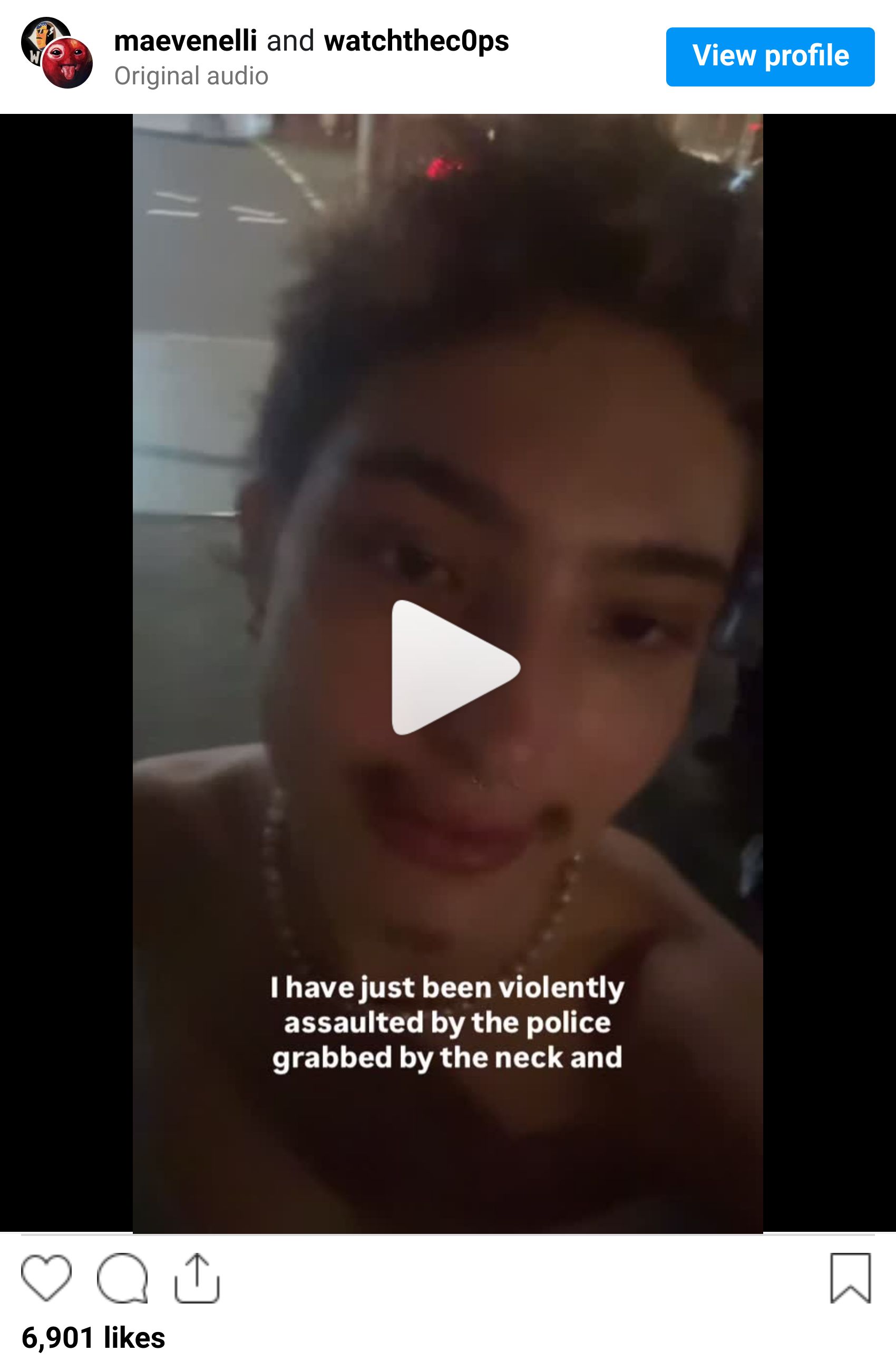
Secondly ‒ breach of the peace? For a Palestine flag?
Of the few flags banned in this country, the Palestine flag isn’t one of them. Nor are the slogan ‘globalise the intifada’ or the red triangle, which Dayenu correctly notes PiP uses.
Whilst the standards for restricting free speech are being alarmingly lowered, there still exists no justification for the police actions. Neither a Palestine flag, nor the phrase ‘globalise the intifada’ or the red triangle are justifications for arresting someone for a breach of the peace. Participating in the PiP snap rally (if they were there ‒ and I’d love to know how police identified them, if they were) before joining the drag king float isn’t a breach of the peace. The individual was separated from their clothing and their possessions, so they weren’t carrying anything else that could justify a breach of the peace ‒ and even if they said something, they were in drag; how can police prove anything they said wasn’t meant as satire?
I remember police officers threatening to arrest someone for a breach of the peace at a protest I once attended. Apparently, to the officer, pointing out facts about the Israeli genocide to a neo-Nazi or Nazi sympathiser was antagonism. I remember a court hearing pertaining to something someone said, and an argument being made that protests allow for more extreme speech than any other environments.
But if Queensland’s recent ban of the phrase ‘from the river to the sea’ is upheld by the courts, if phrase by phrase and word by word all critical speech is criminalised and only silence is permitted, I suppose I should say this now, on the record.
Like all the many, many Jewish people saying ‘not in my name’ across the world, I say this: as a queer femme, Israel doesn’t get to launder the blood of civilians in Gaza, the West Bank, Lebanon and Sudan and Iran through my identity. NSW police don’t get to drape my flag over the bodies of First Nations people. The Liberal party doesn’t get to claim my joy as a ‘tourism attraction’ for itself whilst demonising the trans members of my community and the Labor party doesn’t get to march with me whilst dictating that we can’t march against its policies that we disagree with.
The Sydney Gay and Lesbian Mardi Gras doesn’t get to sell out our community to the people abandoning us right now.
Not without a fight.